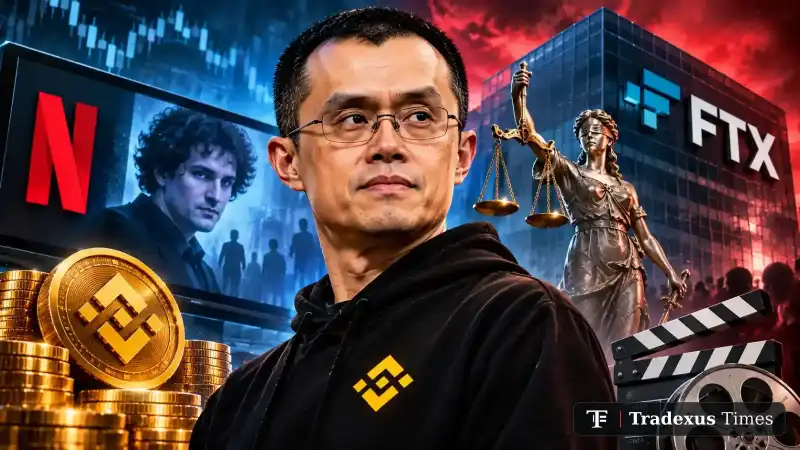
Binance co-founder Changpeng Zhao has pushed back against what he describes as a coordinated effort by well-funded groups to damage his reputation, as Netflix's new limited series, The Altruists, brings renewed attention to the collapse of FTX and the individuals involved in the exchange's downfall.
Zhao raised the issue on X on Friday, one day after the series became available for streaming. Although he did not identify the parties allegedly responsible or provide evidence establishing the existence of a coordinated campaign, he claimed that financially powerful groups were promoting negative narratives about him. In a subsequent post, he shared supportive messages from individuals who had contacted him and argued that the show's portrayal of events was sufficiently inaccurate to change the opinions of some people who had previously viewed him unfavorably. He concluded by indicating that he intended to return his attention to other work.

The controversy places Zhao back in the middle of a public debate surrounding the events that led to FTX's collapse in November 2022. The exchange's bankruptcy exposed an approximately $8.9 billion shortfall in customer funds, making the episode one of the most consequential failures in the history of the digital-asset industry. Netflix's production revisits that period through a dramatized account featuring characters based on several central figures, including Zhao, FTX founder Sam Bankman-Fried and former Alameda Research chief executive Caroline Ellison.
The series features Anthony Boyle as Bankman-Fried, Julia Garner as Ellison and Terry Chen as Zhao. Its characterization of the people involved has already generated criticism from individuals connected to the original events, highlighting the difficulties of translating a complex financial scandal into a dramatic narrative.
Zhao's latest comments also fit into a longer history of his public disputes over media coverage and negative reporting about Binance. In 2023, his use of the number four became a widely recognized expression within the crypto community, referring to his advice to disregard fear, uncertainty and doubt, commonly known as FUD. He has continued to invoke the slogan when challenging information he considers inaccurate. Zhao has also previously alleged that FTX paid $43 million to a news organization to publish negative coverage of Binance, although that allegation should be distinguished from independently established findings.
Criticism of The Altruists has not been limited to Zhao. Constance Wang, FTX's former chief operating officer, expressed dissatisfaction with the production's trailer, saying its opening moments were sufficiently upsetting that she stopped watching. She also questioned the accuracy of the characterizations, arguing that Garner's interpretation of Ellison did not resemble the person she knew and that the real Bankman-Fried was more socially awkward than his on-screen representation.
Wang's reaction illustrates a broader tension surrounding dramatizations of major financial scandals. While entertainment productions can introduce complex events to wider audiences, fictionalized dialogue, character development and compressed timelines can create differences between dramatic interpretation and the historical record. For individuals directly involved, those differences can carry reputational consequences long after the original events.
The series' creative approach has also attracted attention because of its framing of the relationship between Bankman-Fried and Ellison. Its co-creator, Graham Moore, has described the central figures as people who initially considered themselves committed altruists but ultimately rationalized serious wrongdoing. That interpretation introduces a psychological dimension to the story, although it remains a creative framing rather than a substitute for the legal findings established during the FTX proceedings.
Bankman-Fried was convicted on seven felony counts and sentenced to 25 years in prison. His legal challenge has continued, with the Second Circuit upholding his conviction on June 12 and his lawyers subsequently asking the Supreme Court to review the case in September. Ellison, meanwhile, cooperated with prosecutors, served more than a year in prison and was released. Wang has since established Pacifica, a trading platform launched after FTX's bankruptcy.
For the digital-asset industry, the renewed attention surrounding the series highlights how the reputational consequences of the FTX collapse continue to influence prominent figures and public perceptions of the sector. Zhao's allegations remain unsubstantiated in the material available, while criticism from former FTX executives demonstrates that disagreements over the portrayal of the scandal extend beyond Binance's former leadership.
Ultimately, the controversy reflects a continuing struggle over how one of crypto's most damaging corporate failures will be remembered. As dramatizations bring the story to a broader audience, the distinction between documented events, personal recollections and creative interpretation remains essential. The central question is not simply whether the series generates controversy, but whether its portrayal helps audiences understand the underlying financial misconduct without blurring the historical record.