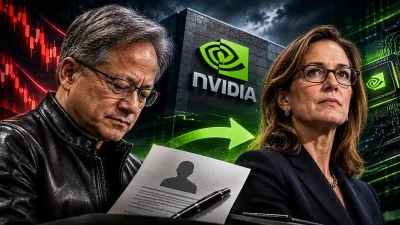
Nvidia has appointed Chief Financial Officer Colette Kress as interim chief executive following Jensen Huang’s resignation, ending his 33-year tenure at the helm of the semiconductor company. Kress will retain her CFO responsibilities while the board conducts a search for a permanent successor, placing one of the technology industry's most financially experienced executives in charge of a business valued in the trillions of dollars.
The leadership transition follows allegations surrounding Huang's personal conduct, including reports of extramarital relationships and claims involving an individual suspected of having connections to Chinese intelligence. The circumstances have introduced an additional layer of uncertainty for a company whose market position, corporate identity and strategic direction have been closely associated with its founder. The board has stated that it has no reason to believe company secrets or US national security were compromised.
Kress brings nearly 25 years of financial and operational experience across major technology businesses. Before joining Nvidia in September 2013, she spent eight years at Texas Instruments, 13 years at Microsoft and subsequently held a senior finance position at Cisco. Her experience includes overseeing Microsoft's Server and Tools division as CFO and managing financial planning and business development functions at Cisco. She holds a finance degree from the University of Arizona and an MBA from Southern Methodist University.
Her appointment at Nvidia came during a considerably earlier stage of the company's development. At the time, Nvidia was primarily associated with graphics processors for gaming, while its subsequent expansion into data-center computing and artificial intelligence transformed its commercial position. Annual revenue increased from approximately $4.13 billion when Kress joined to $215.9 billion in fiscal 2026, representing growth of more than 50 times.
Although Huang remained the central figure behind Nvidia's technological ambitions, Kress played an important role in managing the financial architecture supporting that expansion. Her responsibilities included overseeing financial performance through major strategic developments, including Nvidia's $6.9 billion acquisition of Mellanox. She also became a prominent representative of the company's financial strategy, communicating revenue expectations, margins and demand conditions to investors during earnings calls.
Nvidia's growing investment relationships with companies purchasing its computing infrastructure add another dimension to the financial responsibilities inherited by its interim chief executive. The company's additional $2 billion investment in CoreWeave in January illustrates the increasingly interconnected relationship between semiconductor suppliers and the businesses building AI computing capacity. Maintaining financial discipline while supporting this ecosystem will remain an important management challenge.
However, Kress's financial experience does not automatically resolve the strategic uncertainty created by Huang's departure. Nvidia's competitive position has developed around a combination of advanced chip architecture, software infrastructure and close relationships with developers and major customers. Preserving coordination across these areas will require effective collaboration between executive management and the engineering leadership responsible for the company's technological direction.
The external operating environment adds further complexity. US export restrictions affecting advanced semiconductor shipments to China remain a significant commercial consideration, while scrutiny of Nvidia's business relationships creates additional regulatory and geopolitical exposure. Kress must therefore manage not only investor expectations but also the financial consequences of restrictions affecting access to important markets.
Investor confidence represents an immediate priority. Nvidia had already experienced an estimated $1.27 trillion decline in market capitalization from its October peak before the board's investigation into allegations involving Huang became public. Although the available information does not establish that the leadership transition caused this valuation decline, the combination of executive uncertainty and questions surrounding AI infrastructure spending could complicate the market's assessment of Nvidia's future growth.
The next important test will be the company's fiscal third-quarter 2027 earnings report, scheduled for November 17. The results will provide investors with an opportunity to assess operating performance and management's ability to communicate a consistent financial outlook during the transition. Particular attention will fall on revenue expectations, profitability and the sustainability of demand for Nvidia's computing products.
Ultimately, Kress inherits a company whose financial expansion has been extraordinary but whose leadership structure has been unusually dependent on its founder. Her immediate task is not simply to preserve financial performance; it is to demonstrate that Nvidia's technological and commercial momentum can remain intact under a different executive structure. The board's eventual decision on permanent leadership will help determine how successfully the company separates its long-term institutional capabilities from the influence of the individual who built its modern identity.