US inflation accelerated in October, strengthening expectations that the Federal Reserve will continue tightening monetary policy at its December meeting. Core Personal Consumption Expenditures (PCE) inflation, the central bank’s preferred underlying inflation measure, rose to 3.3% year-on-year, exceeding economists’ expectations and reinforcing concerns that price pressures remain persistent.
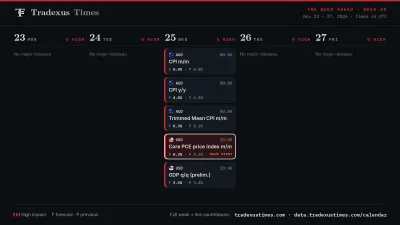
According to data released Wednesday by the Bureau of Economic Analysis (BEA), headline PCE inflation reached 3.8% annually, matching forecasts. Core PCE, which excludes food and energy prices, increased from 3.1% in September to 3.3%, slightly above the 3.2% consensus estimate. Both headline and core measures advanced 0.3% month-on-month.

The acceleration in core inflation is particularly relevant because it suggests that underlying price pressures have not eased sufficiently to give policymakers greater confidence in a sustained return toward their inflation objective. Although headline inflation met expectations, the stronger core reading shifts attention toward the persistence of inflation rather than the broader price index alone.
The timing also puts the Federal Reserve under pressure ahead of its December 8–9 meeting. With the latest inflation data arriving roughly two weeks before the policy decision, the remaining window for economic indicators to materially change market expectations is limited.
Interest-rate expectations already reflect a strong conviction that policymakers will deliver another increase. At 4:01 p.m. UTC on November 25, the CME FedWatch Tool showed a 94.4% probability of a 25-basis-point rate hike in December. If implemented, the increase would move the federal funds target range to 4.00%–4.25%.
Economic growth data provides an additional consideration for policymakers. The US economy expanded at an annualized rate of 4.3% in the third quarter, according to the BEA, above the earlier estimate of 3.4%. Stronger-than-previously-estimated growth could give the Federal Reserve more room to maintain restrictive monetary conditions without facing the same immediate concerns associated with a weakening economy.
However, differences remain within the Federal Reserve over the appropriate pace of tightening. Governor Christopher Waller has indicated support for either two consecutive quarter-point increases in December and January or a single half-point increase in December. New York Fed President John Williams has taken a more cautious position, arguing that the economic situation does not warrant dramatic action.
These differing views highlight the policy challenge facing the central bank: inflation remains elevated while economic activity has proven stronger than previously estimated. The December decision will therefore carry importance beyond the immediate rate adjustment, particularly through the updated economic projections accompanying the announcement.
For cryptocurrency markets, the implications extend primarily through liquidity and the relative attractiveness of risk assets. Higher interest rates increase borrowing costs and improve the yield available from lower-risk assets, potentially reducing demand for volatile investments such as and other digital assets.
The opportunity cost of holding non-yielding assets also rises when interest rates remain elevated. This can make it more difficult for speculative capital to return to crypto markets, particularly when investors are already reassessing exposure to higher-risk investments.
Salman Parcy, managing partner at Cequire Capital, described the inflation report as evidence that price pressures remain less controlled than markets had anticipated. He argued that the data does not necessarily represent a major bearish turning point for cryptocurrencies but could make a near-term recovery more difficult by limiting the Federal Reserve’s ability to ease monetary conditions.
Ryan Kirkley, co-founder and CEO of Global Settlement Network, similarly highlighted the relationship between Bitcoin and technology stocks, arguing that both remain exposed to the same broader liquidity cycle. Under this framework, sustained borrowing costs could continue weighing on demand for both asset classes.
The existing market backdrop adds to that sensitivity. According to CoinGecko data, total cryptocurrency market capitalization has declined approximately 32% since the beginning of the year, falling from around $3.09 trillion on January 1 to approximately $2.09 trillion by November 25.
That contraction means the market is entering the December policy decision from an already weaker valuation base. Additional monetary tightening could reinforce pressure on risk appetite, while a more measured policy outlook could help reduce uncertainty surrounding the availability of capital. Neither outcome is guaranteed, however, as the inflation trajectory remains a central constraint on the Federal Reserve's decisions.
The next major focus will be the Federal Reserve's December statement and updated economic projections. With markets already assigning a 94.4% probability to a quarter-point increase, the central bank's forward guidance may become more important than the rate decision itself.
A signal that additional tightening remains necessary could strengthen expectations for an extended period of restrictive policy, potentially keeping pressure on liquidity-sensitive assets. Conversely, indications that policymakers expect the December increase to be sufficient could help stabilize expectations, although such a shift would require support from subsequent inflation data.
The next PCE inflation report is scheduled for December 23, after the Federal Reserve's December meeting. This means policymakers and markets will have to assess the December decision without the benefit of that subsequent inflation reading.
For crypto markets, the critical question is whether restrictive monetary conditions will continue limiting capital allocation to risk assets or whether the Fed's updated projections provide greater clarity on the potential duration of tightening. With cryptocurrency market capitalization already down roughly one-third year-to-date, the December policy outlook could become an important factor in determining whether a near-term recovery gains traction or faces further macroeconomic resistance.